
The Play
First presented to North American theatre audiences in the 1980's as "The Cockroach That Ate Cincinnati", "The Return of the Cockroach" and "The Cockroach Has Landed", Alan Williams' one-man tour-de-force has been in almost constant production since its inception. Now, due to popular demand, Williams has distilled the work into one compelling performance. Through his character, an aging hippie/rock fanatic turned stand-up comic, Williams ponders the effects of one generation's fixation and belief in the power of rock and roll, from the initial euphoria to the subsequent confusion as the true believers come to realize that, just possibly, world peace may not come about as the direct result of a psychedelic song by The Ultimate Spinach.
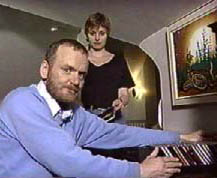
Production of The Cockroach That Ate Cincinnati was a labour of love for award-winning producer/director Michael McNamara . First captivated by the piece when he saw the original production at the theatre festival in 1981, McNamara , fresh out of film school, approached Williams with an offer to put it on film. Times being what they were (the free-spending '80's), however, Williams declined the offer when presented with the budget, which was zero. Over the years, Williams continued to perform the three separate components of his Cockroach series across Canada, eventually creating a single piece called "The Cockroach Trilogy". McNamara, meanwhile, continued to develop his skills as a director, working primarily in music specials and children's television. But they kept in touch, and when Williams was invited to perform the play as part of the special 20th. anniversary performance series at the Tarragon Theatre, McNamara came to watch and approached Williams again. A serendipitous set of circumstances were in place. McNamara had recently been given a crate of stale dated 16mm film from a TV producer friend. The film could either be thrown out, as the station had intended, or tested and put to some use. The stage was set. McNamara now had a load of film stock burning a hole in his pocket, and after being tied up for many years but going nowhere, the film rights to the Cockroach had recently become available. Williams had performed "The Cockroach Trilogy" so many times that the notion of retiring the character onto celluloid was very seductive, and finally, the '80's were over: McNamara still had no money, but neither did anyone else. The die was cast. Williams agreed to give McNamara the rights for a buck and devil take the hindmost. In the summer of 1994, the two immediately sat down to adapt the work for film.
The two worked over six weeks in the spring of 1994 to render the play filmmable. That hot, hot summer in the middle of July, they were ready to go. McNamara gathered together a crew of hardy, wholesome, loyal and hard-working professional friends and family to attack the project in the best tradition of guerrilla filmmaking. In the middle of a heat wave, they headed for 3 all night shoots in the attic of the legendary Squeeze Club. The steamy attic with few windows and no air conditioning. The dusty attic was transformed into a bizarre nightclub by the director's brother, artist Christopher McNamara. Deborah Drakeford, a theatre and television actress who had worked with both Williams and McNamara a number of times, came in to play a supporting role. Tom McCamus, a friend from McNamara's University of Windsor days and admirer of William's work, came in to play the nightclub manager. Everyone worked at a feverish pace. A cameraman made an emergency exit at the end of the first night with an attack of appendicitis. Everything had to be put back in place after each night's shoot to get the club in order for the next day. And even the world of sports became a production factor. The day before the last night's shoot was tense as everyone waited to see if it would be Brazil or Italy to win the World Cup - if it was Italy, the shoot would be over. There would be parades and reveling all night and the noise from the streets would make it impossible to finish the shoot! Luckily for the Cockroach team, Brazil won. (There just aren't as many Brazilians in Toronto.) Finally, on Monday morning, the last roll of film was shot, and the faux nightclub was dismantled. A bleary-eyed sweat soaked crew toasted cheap champagne and orange juice and went off in search of sleep. McNamara went away, anxious to have a look at the processed film. Guerrilla filmmaking. Shoot from the hip. No looking at dailies. One shot and that's it. Then came the call from the NFB. There's a problem. Oh my God. A lens on the camera had malfunctioned and almost the entire film was out of focus. (A wise guy at the Lab in Montreal asked "is this a special effect?") McNamara plunged into a deep despair. But, finally, he gathered himself together, gathered Williams together and decided to try again. But this time they would have to completely rewrite the script. Most of their indoor film had been used up, (not to mention most of the favors to be called in in Toronto. ) So, with their daylight film in their pockets, they left town. Thus began the transformation of the story to the one in the film today. The location became Windsor, the storyteller became the Captain, whose story was to be told by two local aspiring filmmakers, and everyone would stay at McNamara's parents.
The writing evolved over the winter and early spring of 1994/95 and in the spring of 1995, the film began shooting again. Christopher McNamara and the director's brother in law, Patrick Lobzun, helped to put together a crew of fast and loose professional friends from The Detroit Filmmaker's Coalition and "The House of Toast" (yes, that's really the name of Windsor's film co-op). They shot outdoors. Instead of frying, they were freezing. Deborah Drakeford came back to play the filmmaker, Victoria Blossom, and her real life husband Oliver Dennis came to play the film husband and lawyer, Terry. Mrs. McNamara made lunches for everyone. The shoot was completed, the film came back correctly exposed and in focus, and Deborah and Oliver, unknown to the crew at the time, were beginning their own adventure. When McNamara brought the team back to Windsor to shoot an additional scene the following spring, they brought their infant daughter with them.
McNamara spent the fall and winter of 1995 editing the film using an old fashioned (by present film making standards) video editing system donated by Cambium Productions. Having come this far, McNamara decided to add a few additional scenes on the streets of Windsor, but had to wait until the spring thaw of 1996 to get the scenes to match those of the previous year. Some of the new scenes were triumphant, others are still on the cutting room floor (don't ask about the crows!). Based on a rough cut of the film, The Cockroach was invited to premiere at the Toronto International Film Festival. With help from coproducers James Weyman and Judy Holm, a presale to Bravo! The Lively Arts Channel, and a sympathetic bank manager - the film was rushed to completion.